Breaking the Reactive Maintenance Cycle: How Facilities Teams Regain Control

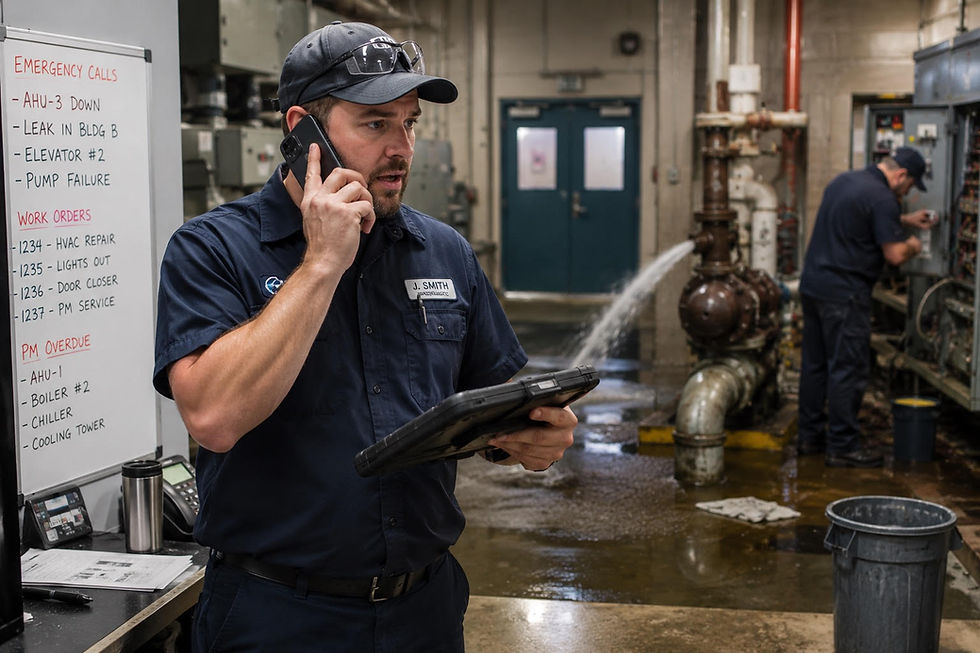
You will either schedule maintenance proactively, or the equipment will eventually schedule failures for you.
The Reality of Maintenance Work Today
Even facilities with strong preventive maintenance programs often struggle to consistently complete scheduled work. Limited staffing, tight budgets, aging infrastructure, and constant operational demands make it difficult to stay ahead.
Then the unexpected happens. A pump fails. An air handler goes down. A leak appears. A tenant or department calls with an urgent issue that cannot wait. Reactive work immediately takes priority, and scheduled preventive maintenance gets delayed, rescheduled, or forgotten entirely.
Over time, many maintenance teams become trapped in a constant “firefighting” mode. Emergency work becomes the focus because it is visible, urgent, and disruptive. Meanwhile, preventive maintenance — the quiet work that prevents failures in the first place — often goes unnoticed because nothing visibly goes wrong when it is done correctly.
Ironically, the better preventive maintenance works, the less people notice it.
The Firefighting Cycle in Facilities Maintenance
Reactive maintenance naturally creates more reactive maintenance.
When preventive maintenance tasks are skipped or delayed, equipment begins operating without proper inspections, cleaning, lubrication, adjustments, or testing. Small problems grow unnoticed until they become major failures.
Those failures create emergencies. Emergencies consume technician time. The additional reactive workload pushes preventive maintenance even further behind schedule. The cycle repeats itself over and over.
Facilities teams end up stuck on an operational hamster wheel:
Equipment gets neglected
Breakdowns increase
Emergency work increases
Preventive work gets delayed
More equipment fails
The longer this cycle continues, the harder it becomes to regain control.
What Gets Pushed Aside — and Why It Matters
When teams operate in reactive mode, the first tasks to disappear are usually the quieter scheduled activities that keep buildings stable and reliable.
These often include:
HVAC seasonal start-ups and inspections
Air filter changes
Fire alarm inspections and testing
Fire sprinkler inspections and testing
Roof inspections
Building envelope inspections
Boiler and water heater servicing
Generator testing
Electrical preventive maintenance
Lubrication schedules for motors and pumps
Documentation and maintenance record updates
None of these tasks may appear urgent today. However, neglecting them almost guarantees future failures.
Preventive maintenance is not “extra” work. It is the work that keeps operations stable.
The Hidden Cost of Reactive Maintenance
Reactive maintenance is expensive in ways that are not always immediately visible.
Consider a simple HVAC filter replacement that gets delayed repeatedly because technicians are tied up responding to emergencies. Eventually airflow becomes restricted, coils freeze, the unit struggles under excessive load, and the system fails.
Now the facility faces:
Occupant discomfort
Emergency service calls
Overtime labor
Higher repair costs
Operational disruption
Reduced equipment lifespan
A relatively inexpensive preventive task turns into a costly emergency repair.
The same pattern applies across nearly every building system. Deferred maintenance slowly compounds until failures become unavoidable.
Beyond repair costs, constant emergencies also create technician fatigue, stress, rushed decision-making, and declining morale. Teams spend more time reacting and less time improving the facility.
Why Preventive Maintenance Keeps Losing Priority
One of the biggest challenges with preventive maintenance is perception.
Reactive work feels urgent because everyone sees the immediate impact. A failed HVAC unit, flooded mechanical room, or power issue demands attention and creates visible pressure to respond quickly.
Preventive maintenance works differently. When it succeeds, nothing happens.
Because failures are prevented quietly in the background, preventive work is often viewed as less important than emergency repairs. In some organizations, it is treated as filler work rather than operationally critical work.
That mindset creates long-term problems. Every skipped inspection, delayed service interval, or missed testing cycle increases future risk.
Facilities do not become reactive overnight. They slowly drift into it through accumulated neglect.

The Turning Point: How Teams Break the Reactive Cycle
Preventive maintenance only works when there is structure behind it. More importantly, this is where facilities teams begin climbing out of the reactive cycle. The shift away from constant firefighting does not happen accidentally — it happens through planning, scheduling, prioritization, and consistency.
A successful maintenance program requires:
Clear scheduling
Defined priorities
Accurate asset information
Labor planning
Material coordination
Technician accountability
Work tracking and documentation
Critical equipment should be identified and prioritized first. Workloads must be balanced against available staffing and skill levels. Required parts and materials should be secured before work is scheduled whenever possible.
Without planning, preventive maintenance becomes reactive maintenance waiting to happen.
Scheduling is equally important. If preventive work is not formally scheduled, protected, and tracked, reactive work will consume every available hour.
This is the point where facilities teams begin turning things around. Once preventive maintenance becomes structured, prioritized, and consistently scheduled, the organization slowly starts regaining operational control.
Practical Ways to Rebalance Reactive and Proactive Work
Facilities teams rarely move from fully reactive to fully proactive overnight. The transition is gradual.
The goal is not to eliminate reactive work entirely — emergencies will always happen. The goal is to prevent reactive work from controlling the entire operation.
5 Steps Facilities Teams Can Start Using Immediately
Shifting away from reactive maintenance does not happen overnight, but small operational changes made consistently can begin improving reliability almost immediately.
1. Review and Prioritize Work Orders Daily
Review all open reactive and preventive work orders together and prioritize them based on operational impact, life safety, reliability, and occupant comfort.
Not every “urgent” call is actually critical.
2. Protect Time for Preventive Maintenance
Block dedicated time each day or week for scheduled maintenance activities.
If preventive maintenance only happens “when there’s time,” it usually never happens.
3. Focus on Critical Equipment First
Start with systems that create the biggest operational impact when they fail:
HVAC systems
Boilers
Pumps
Electrical distribution equipment
Fire and life safety systems
Domestic water systems
Improving reliability on critical assets delivers the fastest operational improvements.
4. Eliminate Repeat Failures
Identify recurring reactive work orders and address the root cause instead of repeatedly applying temporary fixes.
If the same equipment keeps failing, the facility is not solving the problem — it is managing the symptoms.
5. Build Consistency Before Perfection
The goal is not to create a perfect maintenance program immediately. The goal is to create a consistent one.
Small improvements repeated consistently will gradually shift the maintenance culture from reactive to proactive.
What Good Balance Looks Like
Well-managed facilities still experience reactive work. The difference is that emergencies no longer dominate the entire maintenance operation.
Strong maintenance teams intentionally schedule preventive work as a true operational priority. Preventive maintenance is often planned earlier in the day or earlier in the week so that unexpected issues later on do not completely derail the schedule.
As preventive maintenance improves, several things begin happening simultaneously:
Equipment reliability improves
Emergency breakdowns decrease
Technician stress decreases
Planning becomes easier
Operational interruptions become less frequent
Maintenance costs become more predictable
Over time, proactive work begins leading the operation instead of reactive work controlling it.
Final Thoughts: Moving from Chaos to Control
The shift from reactive maintenance to controlled maintenance starts with visibility and discipline.
Facilities teams must understand what work exists, what work matters most, and when that work needs to happen. Every work order — reactive or preventive — should be reviewed, prioritized, and managed intentionally.
Preventive maintenance is not simply a calendar exercise. It is a long-term operational strategy that protects equipment, stabilizes facilities, reduces emergencies, and improves overall reliability.
The reality is simple:
You will either schedule maintenance proactively, or the equipment will eventually schedule failures for you.


Comments